

Bruno Fernandes contract stand-off leaves Manchester United facing an awkward choice
Manchester United have reached a familiar sort of crossroads, the kind that says as much about the club’s internal hierarchy as it does about the player at the centre of it. According to TeamTalk, Bruno Fernandes is weighing up his options as talks over a new contract drift without resolution, and the shape of the dilemma feels revealing.
On one level, this is straightforward. Fernandes wants security, status and a deal that reflects both his importance and his longevity. United, for their part, appear hesitant over committing to the length and financial package he seeks. The result is a negotiation that has started to develop its own weather system, with uncertainty, irritation and strategic leaks beginning to gather around it.
The key detail is not simply that Fernandes wants to stay. It is that he wants to stay on his terms. TeamTalk reports that the Manchester United captain is pushing for an agreement through to 2030, a contract that would take him close to his 36th birthday. The club, while holding an option that could keep him until 2028, have shown reluctance to go quite that far. In modern elite football, that is rarely a minor distinction. It is where planning meets sentiment, and where a club decides whether it is rewarding past value or buying future output.
Manchester United weighing risk against reward
Fernandes remains one of the defining figures of this United side, a player whose influence has often extended beyond chance creation and goals into the more abstract business of carrying responsibility. Those players can become indispensable in lean periods. They can also become difficult to price in the cold language of squad-building.
That appears to be where United now find themselves. TeamTalk states that intermediaries are beginning to test the market, although the level of interest is not especially broad at this stage. That alone introduces a subtle complication. A player of Fernandes’ profile might once have expected Europe’s established superclubs to circle instinctively. Yet the report says neither Paris Saint-Germain nor Bayern Munich have shown interest in the past year, and neither is expected to move for him now.
That matters because it narrows the map. It reduces the number of elegant exits and leaves the conversation shaped less by continental prestige than by opportunity, timing and compromise. For Fernandes, that is a very different sort of reckoning.
Saudi Arabia and Turkey emerge in Bruno Fernandes picture
The article points to Saudi Arabia as a live possibility. Fernandes seriously considered that route in 2025 before rejecting an approach from Al-Hilal. TeamTalk adds an important clarification, that while the midfielder has suggested United looked to sell him at the time, the first exploratory moves came from his own camp. This time, Al-Hilal are said to have cooled their interest under Richard Hughes, though other Saudi Pro League clubs are still attentive.
Turkey also remains in view. Galatasaray have reportedly stepped back, but Fenerbahce and Trabzonspor are monitoring developments. That does not necessarily make a move imminent. It does, however, give Fernandes and his representatives a landscape to survey if the current impasse hardens.
There is an unmistakable symbolism in that. The market available to a 32-year-old elite midfielder is not the same as the one open to him at 27 or 28. Clubs are no longer simply buying talent. They are buying the final years of a career, with all the caution that implies.
Michael Carrick uncertainty clouds contract talks
There is another layer to this, and it may be the most telling one. TeamTalk reports that United are expected to use the international break to assess the future of Michael Carrick, and that the managerial situation is one reason Fernandes’ negotiations could slide down the agenda. In institutional terms, that is understandable. Clubs do not like making major commitments without clarity over who will lead the project.
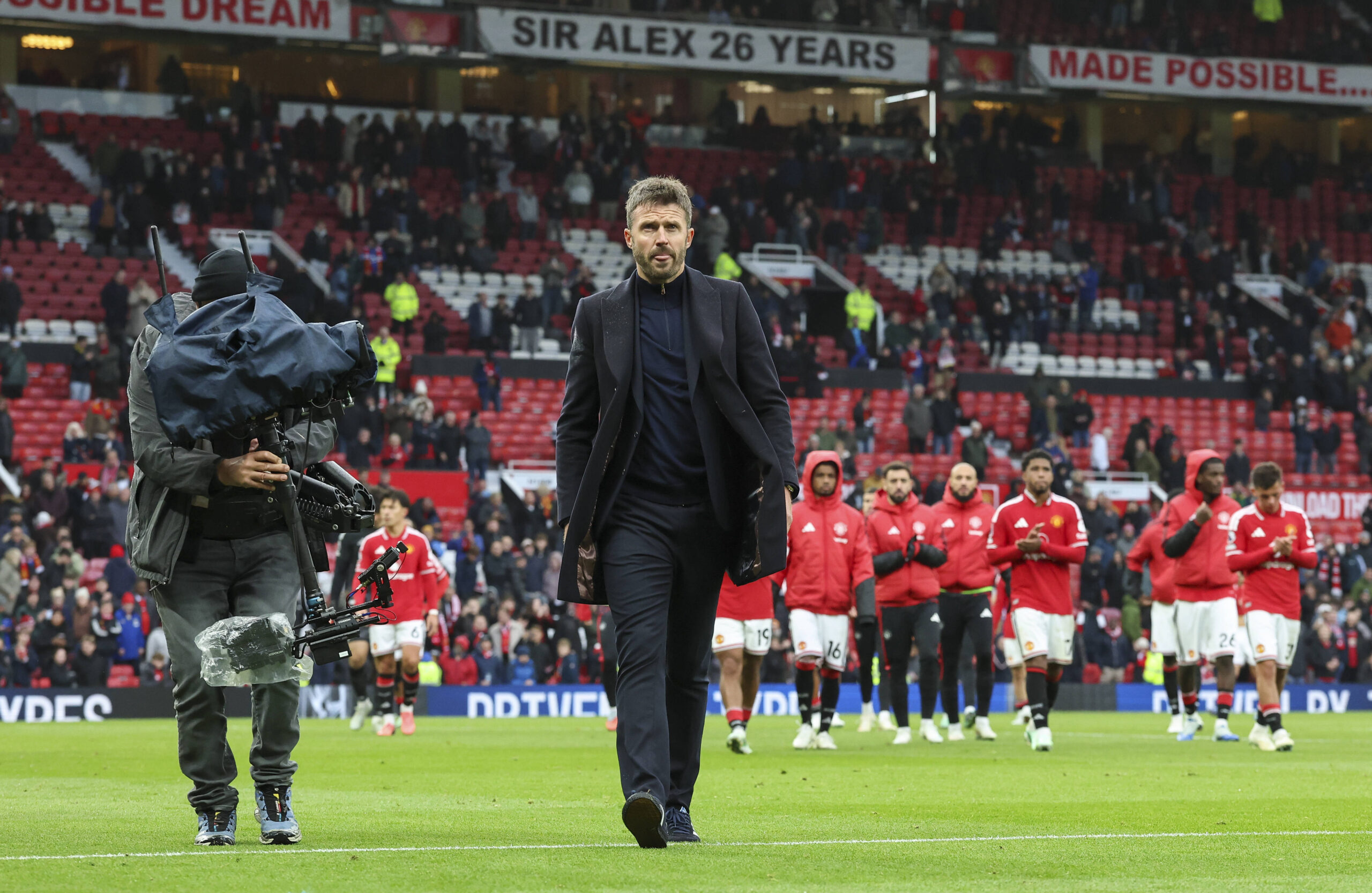
Yet it also hints at the wider disorder that has so often haunted Old Trafford in recent years. Contract strategy, managerial stability and squad planning are meant to run in parallel. At United, they too often appear to collide.
Fernandes’ comments after the defeat in Como have also, according to the report, drawn internal scrutiny. He is said to have insisted that his remarks were not aimed personally at Carrick, but they did little to improve the atmosphere around talks. In a more settled club, such noise might have been managed and absorbed. At a club still trying to define its direction, every comment tends to gather weight.
Decision on Bruno Fernandes will define United’s next step
What happens next will reveal plenty about Manchester United’s current self-image. If they give Fernandes the deal he wants, they are declaring that his leadership and quality remain central enough to justify long-term risk. If they refuse, they are effectively signalling the start of a different cycle, one in which age profile and reset logic take precedence over continuity.
Neither path is inherently wrong. The problem for United is that the delay itself creates instability. Fernandes wants clarity. The club want flexibility. Usually, one side has to surrender something.
For now, TeamTalk suggests further talks are due this month, though a swift resolution is far from certain. That leaves Manchester United in an awkward holding pattern, still dependent on one of their most important players, still unsure how far they are willing to go to keep him, and still vulnerable to the sense that too many major decisions are being made one after another rather than as part of a coherent whole.
In that respect, the contract stand-off is about far more than Bruno Fernandes. It is about whether United can finally make decisions that look joined up.
Our View
This all feels worryingly familiar. Bruno Fernandes can frustrate, he can overplay, he can let emotion spill over, but he is still one of the few players in this squad who looks capable of dragging a match into life. Letting this drift into a stand-off feels careless, especially when there are already questions over Michael Carrick and the broader direction of the club.
The part that gives pause is the contract length. Handing out a deal to 2030 for a player already in his thirties carries obvious risk. United have made enough expensive emotional decisions over the years, and too many of them have lingered on the wage bill long after the football case had faded. That caution is understandable.
Still, there has to be a middle ground between blind commitment and passive delay. If the club truly see Fernandes as captain material, as a pillar of the dressing room and one of the team’s few reliable creators, then the talks should reflect that. If they do not, then they need to be honest and plan for life after him properly.
What cannot keep happening is this half-state where the club seem unsure whether they are building around senior players or quietly preparing to move on from them. Fernandes staying makes sense, but only if it is part of a clear plan. Right now, the fear is that there is no clear plan at all.

