
Freedom Holding Corp. powers WSTC 2025: from global chess rivalry to educational alliance
WHERE SPORTS EXCELLENCE MEETS EDUCATIONAL PROGRESS
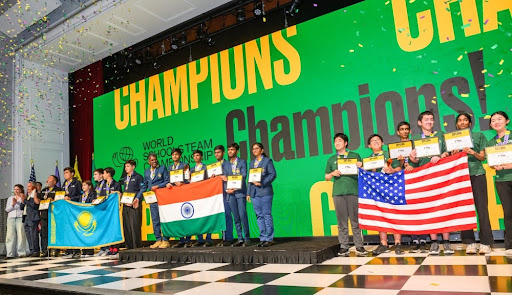
The 2025 World Schools Team Championship concluded on August 7. India’s school team was crowned the undisputed champion after a flawless 8-0 performance, showcasing the growing global reach of chess education. Kazakhstan’s young grandmasters secured the silver medal, and the country leads the world in the number of school teams in the top 10.
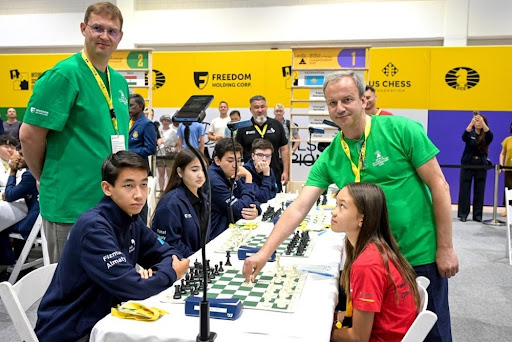
Fifty school teams from around the world participated in the second World Schools Team Championship (WSTC), held from August 2-7 in Alexandria, near Washington D.C., USA. The event was organized by the International Chess Federation (FIDE) and the International School Chess Federation. It was supported by Freedom Holding Corp., a NASDAQ-listed company whose CEO, Timur Turlov, is a big supporter of this ancient sport.
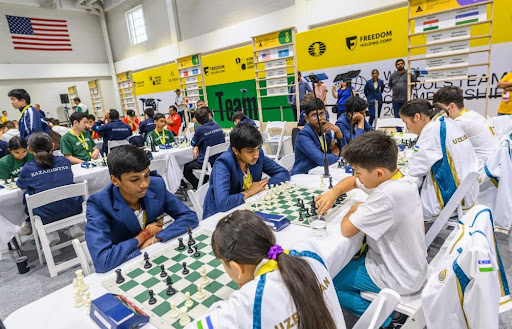
The tournament was played over 8 rounds, following a Swiss format with each team fielding multiple players per round and with no players eliminated. Time control is 45 minutes + 10 seconds per move. Each team consisted of four main players of mixed ages, one reserve, and one non-playing captain.
The Global Battle
The results were published, and the winners were announced on August 6. Velammal MHS School in India took gold, winning all eight games. The National School of Physics and Mathematics from Kazakhstan took second place, earning the same match points as the American team from the Harker School (earning bronze) but surpassing them in the tiebreaks.
At the country level, the main competition was between school teams from the United States and Kazakhstan, as each country was represented by four and five teams, respectively. Kazakhstan’s teams performed impressively — three of their five teams were among the top ten winners by match points, ranking second, fourth, and eighth, respectively. Meanwhile, American teams took third and fifth place in the top ten. The other young participants in the top 10 represented school teams from Sri Lanka (6th place), Armenia (7th place), Uzbekistan (9th place), and England (10th place).
In the individual standings, young chess talents from Kazakhstan, Uzbekistan, and India took the lead, not losing a single game and getting perfect scores: eight out of eight.
Stronger Field and New Format
This year’s WSTC is the second edition of the event, launched two years ago. The inaugural tournament, organized by FIDE, the Kazakhstan Chess Federation, and Freedom Holding Corp., took place in Aktau, Kazakhstan, in August 2023.
In just two years, the tournament took a step forward. This year, it boasted a stronger competitive field. As WSTC 2023 was the first experimental tournament, the level of the teams and players was less important. This time, more top chess teams participated in the championship.
In 2025, the competition within the top tier (2–5) was much tighter than in 2023. Additionally, a broader mix of top-performing schools from strong chess nations, such as India, Kazakhstan, the USA, Armenia, and Uzbekistan, participated in the tournament this year, with all of them placing in the top 10 in 2025. Merging the age categories (no longer split into 12-year-olds and under 18) increased competition as younger players faced older, stronger opponents.
A New Dimension
In addition to the quality of the competition itself, this year’s WSTC evolved beyond a mere sports event. While the 2023 tournament focused on the competition itself, the 2025 event was paired with the Smart Moves Summit, a two-day conference about the role of chess in school education. This added an additional dimension that the inaugural WSTC lacked.
At the summit, specialists from FIDE, the International School Chess Federation (ISCF), education, research, technology, government, and chess advocacy sectors discussed important issues such as elevating chess to a “second literacy” alongside reading and math, balancing educational technologies—such as AI-driven chess platforms and virtual reality (VR)—with human interaction, and designing public-private partnerships to support the implementation of chess in schools.
After the summit, participants signed an official declaration outlining principles for global integration of chess into formal and informal education. All in all, WSTC 2025 was about maturing the event—raising the competitive bar, connecting chess with global education policy, securing more corporate backing, and producing a tangible output.
Timur Turlov, CEO of Freedom Holding Corp. and President of the International School Chess Federation, believes that WSTC can bring systemic change: “A chessboard is a very good test for all of us, and it’s also very good training. We launched this initiative, and we believe that maybe this could be one of the solutions that can help our kids to better adapt to this fast-moving world. Because the world will continue to change, and the speed of these changes will continue to accelerate.”

